Tropical Storm Dolly has erupted in the Atlantic Ocean, and early forecasts warn that the cyclone could be headed directly towards the US East Coast.
The National Hurricane Center (NHC) announced that Dolly had quickly developed into a tropical storm at 11am ET on Thursday.
It jumped past the first stage of cyclone development, known as a tropical depression, bursting to life with sustained winds of more than 40 mph.
Early spaghetti models, which track all possible paths of tropical storms and hurricanes, show a strong likelihood that Dolly will barrel directly towards Puerto Rico and the Dominican Republic.
From there, multiple tracks predict the storm will reach Cuba, the Bahamas and the coast of Florida.
Some tracks from the American model, known as GFS, suggested that Dolly could move as far north as the Carolinas. However, forecasting models can shift dramatically once storms form and get closer to making landfall.
NHC officials have noted that Dolly may be a ‘short-lived tropical storm’ which encounters strong wind shear in the Atlantic that prevents it from becoming a hurricane.
However, AccuWeather forecasters warned that there is path for the cyclone to make it through the chaotic Atlantic air and even grow into a bigger storm closer to the Eastern US.

Tropical Storm Dolly (Pictured) formed in the Atlantic Ocean on Thursday, August 27

Forecasting models predict that Tropical Storm Dolly will follow a straight path to the Caribbean islands and US East Coast
AccuWeather Lead Hurricane Expert Alex DaSilva said in a statement: ‘If Dolly can survive the dry air, wind shear and land interaction near the islands, the environment does become more conducive for development and strengthening off the Southeast coast mid-to-late next week.’
Heavy rainfall is expected to begin impacting the Virgin Islands, Puerto Rico and Hispaniola this weekend.
Puerto Rico is currently ranked as having the highest risk from tropical rain and severe wind from August 27 through September 9, according to AccuWeather.
The weather service added that the entire East Coast and the Gulf Coast also face a ‘low’ risk of tropical rain and wind from the approaching storm, with the warning stretching from Texas to Maine.
‘There is certainly a chance for this wave to bring rain to Southeastern US one way or another. The question is in what form?’ DaSilva added.
The naming of Tropical Storm Dolly just days after the death of legendary singer Dolly Parton was purely coincidental, as the lists of named storms for each Atlantic hurricane season are publicly released years in advance.
The National Hurricane Center has already announced the names for tropical storms and hurricanes that could form until 2031.
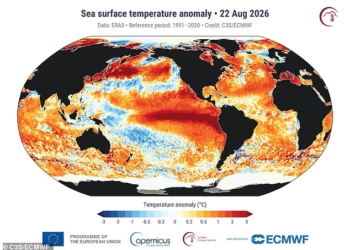
While Dolly is believed to have found a narrow corridor in the Atlantic which allowed it to grow into a large, organized cyclone, meteorologists have pointed out that the impact of a ‘Super’ El Niño around the globe has quieted the usually busy hurricane season.

Pictured: Satellite image of Tropical Storm Dolly in the Atlantic Ocean on August 27

Meteorologists warn that Tropical Storm Dolly may follow a path that allows the storm to strengthen closer to the US
El Niño forms when the surface temperature of the Pacific Ocean becomes noticeably warmer than its historical average. A Super El Niño means those temperatures rise by more than 3.6 degrees Fahrenheit (2.0 degrees Celsius).
This flips weather patterns worldwide, causing more hurricanes to form in the Pacific while preventing storms from gathering strength in the Atlantic by causing more wind shear and drier air that tears apart the structure of cyclones.
Dolly is only the fourth named Atlantic storm to develop this year even though hurricane season officially began three months ago. Hurricane season lasts until November 30.
For comparison, there have already been 12 named storms in the Pacific this summer, including multiple storms impacting the Hawaiian islands.
Currently, NHC is not tracking any other potential storms throughout the Atlantic which could form in the next seven days.
The last tropical storm to form before Dolly was Cristobal on August 12, but that cyclone never approached the US and only held its strength for a day.
Long-range forecasters recently downgraded their predictions for the 2026 Atlantic hurricane season due to the emergence of the Super El Niño.
As of July 7, AccuWeather changed its prediction to between eight and 14 named storms in the Atlantic this year, down from their prediction of 11 to 16 in March.
However, AccuWeather still predicted that four to seven of these storms will reach hurricane strength, and that three to five named storms will make landfall in the US.
AccuWeather’s Lead Long Range Forecaster Paul Pastelok told the Daily Mail in June: ‘It only takes one storm, and then boom! We’re not saying that El Niño is going to weaken and dampen the Atlantic Basin season completely.’
‘There’s still a lot of warm water, a lot of potential there. So, [I] just wanted to make sure [if] people were saying, “Oh, we don’t have to worry about anything this year.” That’s not true. It only takes one storm.’