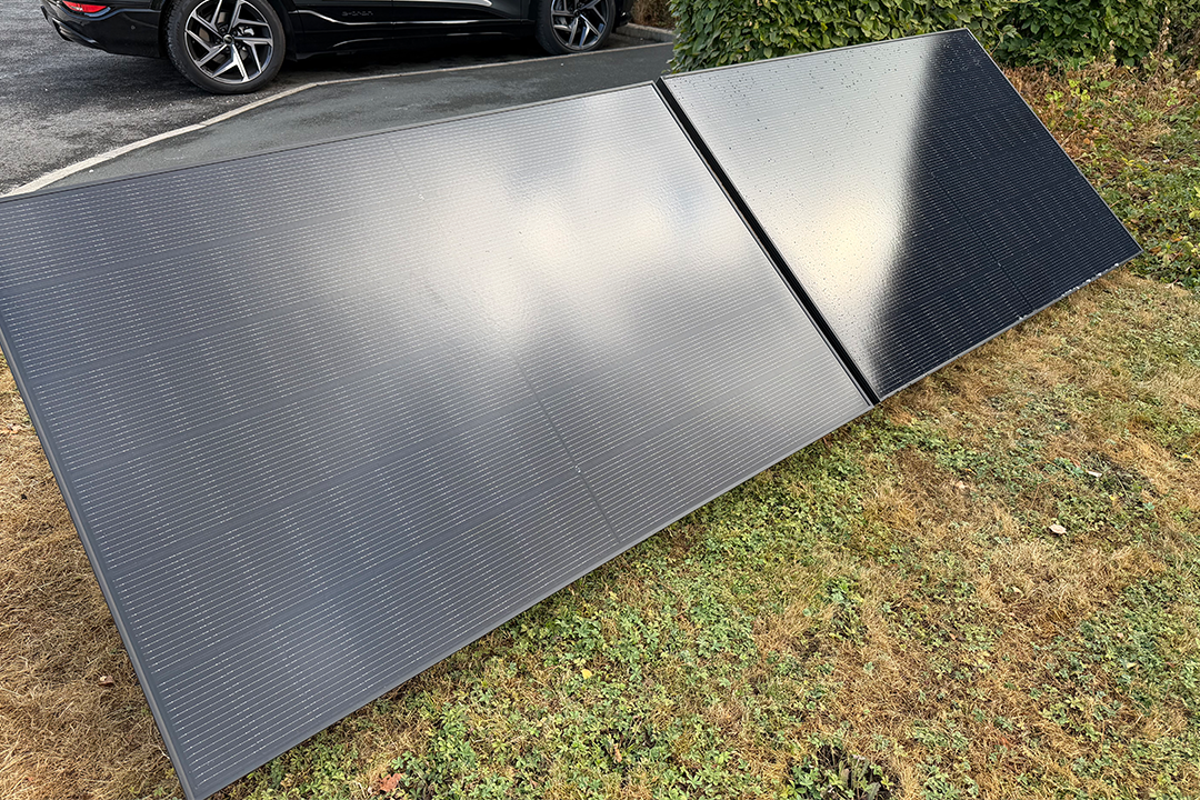
Plug-in solar panels have gone on sale today, 27 August, giving households a new way to generate electricity without paying thousands of pounds for a conventional rooftop solar installation.
The rule change allows compliant systems with an AC output of up to 800W to be connected directly to a suitable household socket. Unlike a traditional solar array, these smaller systems can be installed by the homeowner and positioned in a garden or, where the rules allow, on a wall or balcony. However, only products that meet the government’s new plug-in solar device interim product specification qualify under the new rules.
And, for the first time, there are now compliant products that you can actually order. UKSOL has secured compliant listings on the Energy Networks Association’s Connect Direct register for its plug-in solar pro range. Retailers such as City Plumbing have begun listing its first ground-mounted systems.
Other big-name retailers, including B&Q, Currys, Amazon and Lidl, have been working with the government on the introduction of plug-in solar, although they have yet to announce complete ranges of their own.
We’ll be covering the plug-in solar launch live throughout the day, bringing you the latest product announcements, prices, retailer availability, safety advice and reaction as it happens.
Read more: Best plug-in solar panels so far
The first compliant plug-in solar systems are beginning to appear online. Argos is the first UK retailer to sell plug-in panels online, with prices from £599. It has listed five models that meet the full requirements for the new plug-in solar compliance, all from UKSOL. These kits come complete with everything you need to get started; you just need to set them up and plug them into a standard AC socket.
The cheapest kit currently available to buy at Argos is £599 and is the UKSOL 515W pro compact plug-in solar with hybrid mount bundle. It offers a 515W single solar panel system with adjustable mounting options. The panel then plugs into the 800W microinverter, which can connect via wifi or Bluetooth to the monitoring app on a mobile device. The small microinverter is IP67-rated, so you can leave it outside and run the supplied 4m cable into the house or apartment to plug in.
Elsewhere, energy provider Octopus has released its plug-in solar bundles. There are two available with prices starting from £450, making it the most affordable option currently.
Before buying, you should check that the exact product and model number appears as compliant on the ENA Connect Direct register. A similar-looking solar panel, microinverter or European balcony solar kit is not automatically covered by the new rules.
Read more: Best solar panels, compared
Octopus launches plug-in solar panels
Energy company Octopus has launched its plug-in solar panels, with delivery estimated by the end of September.
Eva Waite-Taylor27 August 2026 18:26
When did the new plug-in solar rules take effect?
The legal changes allowing plug-in solar came into force in the UK on 27 August 2026. As The Independent previously reported, only products that comply with the government’s interim specification will be covered by the new exemption.
Only complete systems that comply with the government’s Interim Product Specification qualify for the new plug-in route. They must have a maximum AC output of 800W and meet specific requirements covering the inverter, plug, cable, electrical protection, labelling and instructions. Battery-integrated plug-in solar systems are not included under the new rules.
There is also a limit on how many systems can be connected. Although the government’s product specification allows one plug-in solar device per household electrical circuit, new G98 network rules approved by Ofgem restrict households to one plug-in solar device in total. The G98 amendment took effect alongside the legislation on 27 August.
Households must also notify their Distribution Network Operator (DNO) when a plug-in solar system is connected. The revised G98 rules introduce a simplified route intended to make this possible for consumers without requiring a professional solar installer.
The new electrical rules apply in the UK – England, Scotland and Wales – but not Northern Ireland, which operates under a separate electricity safety regime.
Jeff Meyer27 August 2026 18:00
Will Wickes sell plug-in solar panels?
Yes. Wickes has confirmed that plug-in solar products are coming to its website.
Chief executive David Wood said the retailer expects to make the products available online “in the coming weeks”, although it has not yet announced which manufacturers or systems it will stock.
Jeff Meyer27 August 2026 17:00
UK safety rules stricter than Germany’s
Ministers say Britain’s new plug-in solar safety specification is more stringent than the rules in Germany, where balcony solar is already well established. The government says the UK regime was developed following independent testing of the key electrical components, with only compliant products permitted under the new plug-in rules. Germany, meanwhile, added around half a million new plug-in solar devices last year alone.
Jeff Meyer27 August 2026 16:02
What to check before buying a plug-in solar panel
The most important thing is to check that the exact plug-in solar system you are buying is approved for the new British plug-in solar route.
Manufacturers must have their complete product assessed against the government’s Interim Product Specification and registered through the Energy Networks Association’s Connect Direct system. Shoppers should therefore check the exact manufacturer and model rather than assuming a product is compliant simply because it has a UK three-pin plug or is advertised as “G98 compatible”.
This is particularly important when shopping through online marketplaces. Balcony solar systems are already widely available elsewhere in Europe, but a European kit can’t be connected legally to a British household socket. Adding a travel adaptor or UK plug to an imported system does not make it compliant.
You should also check where the system can safely be positioned, whether your electrical installation and socket are suitable, and whether you need permission from a landlord, freeholder or managing agent. Extension leads, multi-way adaptors and plug-in RCD adaptors should not be used in place of the manufacturer-supplied connection.
The current G98 rules also limit households to one plug-in solar device, even if the property has several separate electrical circuits. Householders must notify their Distribution Network Operator after connecting a compliant system.
Jeff Meyer27 August 2026 15:30
Solar demand is already at record levels
Plug-in solar launches against a backdrop of record demand for home renewables. Almost 150,000 certified solar installations were completed in the first half of 2026, according to MCS figures cited by the government, up 17 per cent on the previous record start to a year and equivalent to one installation every 74 seconds. Battery installations have also almost doubled year on year, reaching around 36,000 over the same period.
Jeff Meyer27 August 2026 15:05
Not every small solar kit is ‘plug-in solar’
There is perhaps some confusion right now as people try to understand what counts as “plug-in solar” under the new rules. Shoppers may have already come across compact solar kits marketed as “balcony solar” or “plug and play”, but that doesn’t necessarily mean they qualify as plug-in solar under the new rules that came into force today. Some systems can legally be sold and used in Britain but still need to be hard-wired into the home’s electrical system by a qualified electrician, rather than connected directly to a suitable household socket.
EcoFlow’s STREAM Balcony Kit is one example. The company sells the system on its UK website, but its UK installation guidance says the STREAM Microinverter must currently be connected to the distribution board by a professional installer or electrician. EcoFlow also states in its own guidance that its current products do not meet the exact requirements to be classified as true plug-in solar under the new framework.
Under the new rules, compliance applies to the complete system rather than just the solar panel or inverter. If you’re unsure whether a product qualifies, check the exact make and model on the Energy Networks Association’s Connect Direct register before buying or connecting it.
Hard-wired systems like the EcoFlow STREAM Balcony Kit are perfectly legitimate and powerful systems that can save you money on your energy bills. They just don’t benefit from the new DIY three-pin-plug exemption. So it’s important to read the fine print and know what you’re buying.
Jeff Meyer27 August 2026 14:53
Why do some plug-in solar kits exceed 800W?
Some of the new plug-in solar kits now on sale are labelled 890W, 1,030W or even 1,260W, despite the new rules limiting plug-in solar systems to 800W. Some readers may be wondering how that’s possible. It’s because the larger figure refers to the combined generating capacity of the solar panels, while the 800W limit applies to the AC power the system can feed into the home.
A kit might therefore use more than 800W of panel capacity but pair it with an 800W microinverter, which caps the output before it reaches the household circuit. Oversizing the panels can also help the system produce closer to its 800W maximum for longer periods when sunlight is weaker.
Jeff Meyer27 August 2026 14:37
Do you need planning permission for plug-in solar panels?
In England, planning rules also changed on 27 August 2026 to expressly include plug-in solar within existing permitted development rights for domestic solar panels. This means many systems can be installed without making a full planning application, provided they meet the relevant conditions.
However, the rules are not unrestricted. Among the new conditions, plug-in solar cannot be attached to a wooden wall, balcony or other wooden enclosure, or to parts of a building clad in timber. Similar restrictions apply to wooden fences, gates and other boundaries where panels are positioned within a garden. The usual restrictions affecting listed buildings, conservation areas and other protected locations can also apply.
Planning rules differ in Scotland and Wales, so people outside England should check the requirements where they live. Renters and leaseholders should also obtain any permission required by their tenancy agreement, lease, landlord or freeholder before installing panels.
Jeff Meyer27 August 2026 14:30
Check before you plug in
Not every solar panel sold with a three-pin plug is automatically legal to connect under the new rules. Buyers should check that the exact system is listed as compliant on the Energy Networks Association’s Connect Direct register and follow the manufacturer’s instructions.
The revised network rules also limit homes to one plug-in solar device, and people must notify their Distribution Network Operator after connecting it.
Jeff Meyer27 August 2026 14:07