President Kassym-Jomart Tokayev called for greater responsibility and pragmatism among global leaders and renewed efforts to reform the United Nations during remarks at the Antalya Diplomacy Forum on April 17.
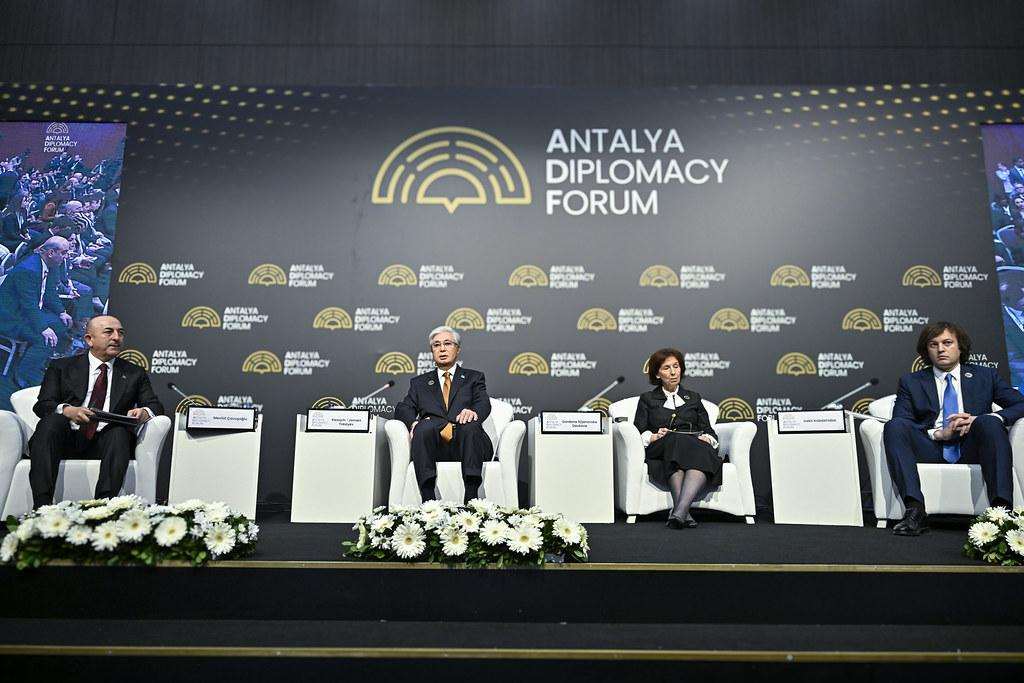
Speaking at a high-level panel, Tokayev emphasized that leadership today should be defined by restraint and accountability, particularly in matters of international peace and security.
“I would say the most important thing: global leadership and those people who are heading their own states in each part of the world must be responsible with regard to international security and peace, and then must be very much restrained. Strategic restraint plays an extremely important role nowadays,” he said.
Tokayev pointed to growing regional conflicts that increasingly spill beyond their borders and become global in scale.
“Regional conflicts nowadays go far beyond regional dimensions. They become global,” he added.
UN reform
Tokayev stressed that while the United Nations remains “indispensable and universal,” its effectiveness is being undermined by long-standing structural issues.
“Everyone is speaking about the necessity of supporting the UN, it is true, as well as everybody saying it deserves to be not only supported but reformed,” Tokayev said. “We should be very frank that nobody believes it might be the case very soon, at least.”
He acknowledged that discussions about reforming the UN had begun a long time ago but had not reached any meaningful conclusions.
“We must be very sincere to say that it is the Security Council that serves as an impediment to reforming the UN,” he said.
Tokayev also raised concerns about the diminishing role of international institutions and the growing influence of emerging technologies.
“Major negotiations happen beyond the platforms of the United Nations and other major international organizations. We never see a higher representative of the United Nations mediating those conflicts. It’s a huge problem. It’s about marginalizing the United Nations. I’m very much concerned,” said Tokayev, who used to serve in top roles at the UN, including as UN Deputy Secretary-General.
Responsible behaviour
Tokayev went on to say that the so-called middle powers, including Kazakhstan and Türkiye, are often more responsible actors on the international stage.
“Regional powers or medium-sized powers or even small powers behave much more responsibly on the international arena,” he said.
He spoke positively about the role Kazakhstan and Türkiye could play in tackling the acute issues of today. He commended Türkiye and its president, Recep Tayyip Erdoğan, whom he described as “his brother.”
“Kazakhstan and Türkiye could play a very positive role, I would say, a huge role in tackling most acute issues that unfortunately do emerge from time to time in our part of the world,” he said, welcoming the upcoming visit of Erdogan to Kazakhstan in May.
Middle East tensions
Tokayev also highlighted Kazakhstan’s position on tensions in the Middle East, particularly around Iran, calling for restraint and diplomacy.
“Everybody is talking about Iran. Of course, it’s a very complex issue. It’s not so easy even to make any comments,” he said. “At the same time, we [Kazakhstan] have expressed our solidarity with the Persian Gulf and called all states to exercise strategic restraint and to stop military actions in that part of the world.”
He added that nuclear issues should remain central to negotiations.
Crisis of leadership
North Macedonian President Gordana Siljanovska-Davkova echoed Tokayev’s remarks, stressing the need for responsible leadership.
“Indeed, what we need is responsible and inspirational leaders in this era of a terrible crisis of leadership. We need politics based on evidence, politics as the art of the possible, not who, where and how wins. Always the same story, she said.
“How do I see the world? It’s based on might, not right,” she said. “There’s a terrible crisis of democracy. Security threats and military uncertainty are very present. Unpredictable world, then also decline of multilateralism.”
She expressed concern about the rising military expenditures. “$2.73 trillion in 2024 was for military means, weapons,” she said. “This is very, very worrying.”
She also pointed to the urgency of “re-examining” the Security Council.
“We have to strengthen the General Assembly position and to reexamine the composition of the Security Council, and I must not forget, as a woman, after tons of documents and materials about gender equality and balance, it’s the right time to elect a woman as Secretary General,” she said.
“We, women, after 80 years [of the UN], deserve as somebody who cares about life more than men, to show that this is not just the men’s world. We, women and our children, are always innocent victims,” she said.