Design and setup
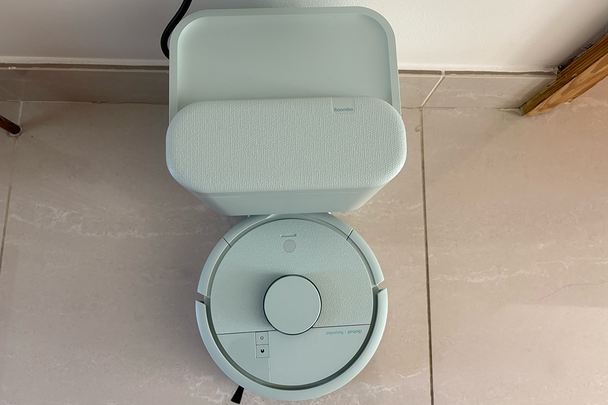
When I unboxed the iRobot Roomba mini I was genuinely impressed at its compact size. In a home that’s full of black and grey appliances, I love how the mint green design brings a pop of colour to the home (it’s available in a pastel pink, too).
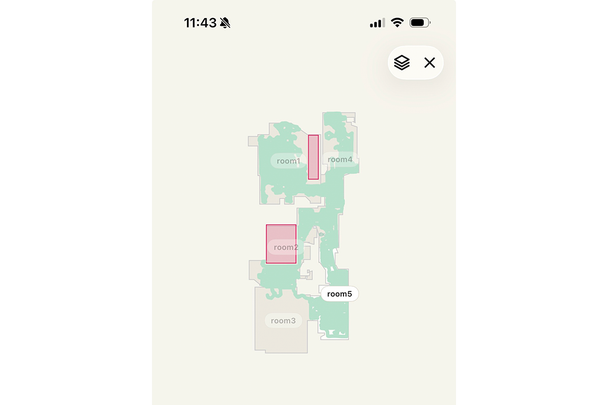
Setup was a breeze – all I had to do was click on the brush and find a spot for it to live that allowed a meter or so of clearance either side. The Roomba Home app clearly guided me through wifi pairing and mapping, without any need to consult an instruction manual. It created a comprehensive and accurate map of my ground floor, and was ready to start vacuuming in no time.
Whether you want to vacuum a specific room, spot clean a certain area or schedule regular cleans, the Roomba Home app is simple and intuitive to use. It was a bit glitchy on the odd occasion, but this was nothing a quick refresh couldn’t sort.
Scheduling was spot on, and it never missed a scheduled clean. However it’s worth noting that you can only schedule the robot to vacuum. In order for the Roomba mini to mop your floors, you need to attach a mop pad, and this disables the vacuuming function, but more on that later.
Cleaning
If I’m honest, I was sceptical that such a small robot vacuum would have the cleaning power to tackle the dirt and dust in the busiest areas of my four-person household. However when I put it to the test, I was genuinely impressed at its ability to suck up fine and large debris with little issue.
When I sent it to clean flour that had fallen on my kitchen floor after making bread, it picked it up with ease. Some robot vacuum brushes have a tendency to just fling fine dirt away, but the brush on the Roomba mini mostly guided the fine dirt into the path of the robot and before I knew it my tiled kitchen floor was left sparkling again.
Robot vacuums can often struggle on carpet but the Roomba mini was as effective on the one carpeted area of my house. However, it was noticeably louder when going across carpets and rugs. A word of caution – keep the Roomba mini off thick pile rugs. When it went over one in my living room, the brush got tangled in the rug pile. When I tried to free it, the silicone arm of the brush broke off. With this in mind, I would have appreciated an extra brush in the box or one that’s more durable.
As the Roomba mini is smaller than most robot vacuums, the battery does drain quite quickly. When I set it to clean all five rooms on the ground floor of my house (a dining room, living room, kitchen and hallway), it managed to clean three of these rooms before the battery depleted to 21 per cent. When the battery reaches this point, it automatically returns to the docking station and then resumes cleaning once it has sufficiently charged (this took a couple of hours).
Keep in mind that every time the Roomba mini docks, it empties any dirt that’s it collected into the docking station. While this is handy, it’s incredibly loud when it does so (almost akin to a plane taking off inside your house). It would almost certainly disturb anyone that’s asleep or on a work call.
Navigation and obstacles
The floor coverage of the Roomba mini is excellent. It starts by cleaning the edges of the room and then goes in for a second clean to cover the centre, rarely missing any spots as it goes. As with most circular robot vacuums, it’s not as effective at reaching dirt that’s really embedded into the edges of a room. However, its brush did a good job at sweeping large bits of dirt out of the edges and putting it in the path of the vacuum.
It avoids most obstacles and manages to clean around furniture with ease. The benefit of its compact size is that it can manoeuvre into tight spaces, where most standard robot vacuums would struggle to fit. It even managed to vacuum between the legs of my office chair without getting itself into a jam.
On the odd occasion where it did get stuck, for example on the base of a kitchen stool, it pushed itself off without me having to intervene. There was also only one instance during testing where it failed to return back to the docking station and I had to step in.
The only object the Roomba mini is not so good at avoiding is wires, which I learnt the hard way when it got caught in a tangle of cables under my desk. Fortunately exclusion zones are easy to precisely set and the Roomba mini abides by them.
Mopping
The mopping feature on the Roomba mini works with mop pads, unlike some robot vacuums that have an on-board container that holds a mopping solution. The mop pad is easy to attach by following the picture instructions and it picked up a fair bit of dust and dirt when I tried it out.
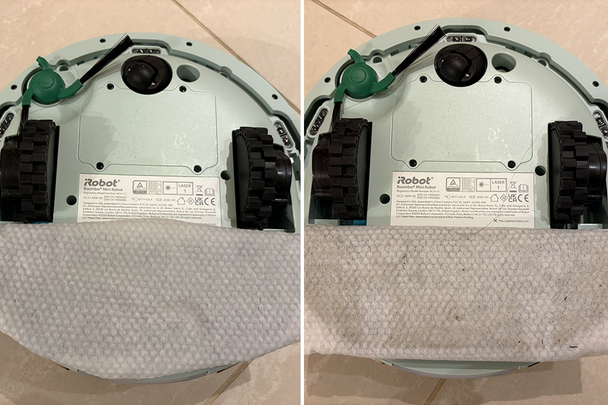
However, compared to my trusty, budget-friendly Flash mop (£11.50, Amazon.co.uk), the Roomba mini left noticeable streaks on my tiled floor. It’s also a bit more hands-on than pricier robot vacuums where the mop pad is always attached and the pads are dried. It’s also important to note that, once you attached the mop pad, this disables the vacuuming mode.
If you’re looking for a decent robot vacuum and mop hybrid, I’d go for our best two-in-one robot vacuum instead, the Roborock saros 10 (£899.99, Roborock.com).