London Mail
  • Home
  • World
  • News
  • Opinion
  • Business
  • Tech
  • Science
  • Sports
  • Lifestyle
  • Health
  • Motering/Cars
  • More
    • Entertainment
    • Travel
    • Crypto
    • Food
    • Home Improvment
      • Real Estate
    • Press Release
No Result
View All Result
  • Home
  • World
  • News
  • Opinion
  • Business
  • Tech
  • Science
  • Sports
  • Lifestyle
  • Health
  • Motering/Cars
  • More
    • Entertainment
    • Travel
    • Crypto
    • Food
    • Home Improvment
      • Real Estate
    • Press Release
No Result
View All Result
London Mail
No Result
View All Result
Home Science

You think this is bad? Met Office warns Britain’s wet weather will continue until at least mid-MARCH

by London Mail
February 18, 2026
in Science
Reading Time: 8 mins read
0
SHARES
Share on FacebookShare on Twitter

If you’re sick of Britain’s relentless rain, forecasters have bad news – as they predict the wet weather is set to continue for another month.

Conditions have been exceptionally soggy since the beginning of the year, with a strong and southern jet stream bringing frequent rain and strong winds.

The south west of England has been particularly battered, experiencing 216 millimetres of rainfall so far – nearly triple the long–term average for this time of year.

It is expected that the wettest weather conditions will move further north from next week, according to the Met Office.

However, the heavy rainfall and ground conditions mean a higher–than–normal risk of impact from the relentless downpours.

Sarah Davies, Head of Energy and Environment at the Met Office said: ‘Wet weather has persisted for many areas over the past few weeks, with repeated Atlantic low pressure systems leaving ground conditions particularly saturated across southern parts of the UK.

‘While it is likely to remain changeable over the next few weeks, with further wet weather at times, the focus for the wettest conditions is expected to shift to western hills, where we would normally expect it at this time of year.

‘However, given some areas elsewhere remain sensitive following recent rain, any further spells of rain as we head into early spring has a higher chance of causing some impacts than normal for this type of setup.’

The Met Office have announced wet weather is expected to continue for another month, until mid-March

The Met Office have announced wet weather is expected to continue for another month, until mid–March

Conditions have been exceptionally wet since the beginning of the year, with a strong and southern jet stream bringing frequent rain and strong winds. Pictured: Intense rainfall during the Hull City v Chelsea match last week

Conditions have been exceptionally wet since the beginning of the year, with a strong and southern jet stream bringing frequent rain and strong winds. Pictured: Intense rainfall during the Hull City v Chelsea match last week

The weather forecast for this Saturday shows a band of rain spreading across the country. The Met Office say soggy conditions are expected to persist until March

The weather forecast for this Saturday shows a band of rain spreading across the country. The Met Office say soggy conditions are expected to persist until March

Groundwater levels across the south and south–east of England are currently rising, leading to minor flooding.

In Somerset, approximately 29 square miles of the Levels and Moors have been flooded, while around 355 have flooded across England – primarily in the south west.

There are currently 65 flood warnings, where flooding is expected, and 179 flood alerts, where it is possible, in place across the country.

Julie Foley, director of flood risk strategy and national adaptation at the Environment Agency, said: ‘With the weather conditions continuing to remain unsettled, I urge the public to remain vigilant to the risk of flooding.

‘Environment Agency officers will continue to work around the clock across the country, supporting communities with pumps, temporary barriers and by clearing waterways to ensure flood water can drain away.

‘Our thoughts are with the households, businesses and farmers who have been flooded. Whilst many thousands of properties have been protected, there is always more to be done to tackle flood risk in a changing climate.’

The Environment Agency said further pumps are being proactively deployed across the Somerset Levels, meaning there are now 28 ultra–high volume pumps.

Temporary barriers are being installed along the Rivers Severn and Thames, including those at Bewdley in Worcestershire and at Oxford. The Thames Barrier is also due to be closed tomorrow as high tides are expected.

Vehicles left abandoned in a flooded ford in Watery Gate Lane, Thurlaston, Leicestershire, as a result of prolonged rainfall

Vehicles left abandoned in a flooded ford in Watery Gate Lane, Thurlaston, Leicestershire, as a result of prolonged rainfall

Flood water from the River Severn covers the Worcestershire countryside and farm land on February 10

Flood water from the River Severn covers the Worcestershire countryside and farm land on February 10

Why is it so wet?

The jet stream is to blame for the particularly wet weather. 

This fast–moving river of air flows several miles above Earth’s surface, and is positioned further south than we typically expect for this time of year. 

‘When the jet stream shifts south across the Atlantic, it tends to funnel low–pressure systems directly towards the UK, increasing the frequency and intensity of rain–bearing weather fronts,’ the Met Office explained. 

Cold plunges in North America have helped to strengthen the jet stream, which is then propelling areas of low pressure towards north–west Europe.

However, high pressure has also established over parts of northern Europe at the same time, resulting in what the Met Office describes as a ‘blocked pattern’. 

This has stopped the jet stream from shifting – and has limited the UK’s chance of drier weather. 

Last week, the Met Office revealed the towns across the UK that have experienced the most rain so far this year.

Topping the list are North Wyke in Devon, Cardinham in Cornwall and Astwood Bank in Worcester.

At the time of the data being published, these towns had been drenched with rain for a whopping six weeks non–stop – the equivalent of 42 consecutive days.

Other soggy towns included Camborne in Cornwall and Liscombe in Somerset, which had both experienced non–stop rain for 39 days.

Meanwhile, a recent study suggested that UK winters are set to get even wetter thanks to climate change.

Research from the University of Newcastle indicates that for every 1°C of global warming, winter rainfall will increase by seven per cent.

‘The findings from our research show that climate change has already made our winters significantly wetter, with a 7% increase in rainfall per degree of global warming,’ said lead author, Dr James Carruthers.

‘This is really concerning, as seasonal rainfall is increasing at a much faster rate than global climate models have predicted. We’re already experiencing changes in UK winter rainfall that global climate models predict for the 2040s – we’re 20 years ahead.’

While most Brits have had their umbrellas at the ready, people living in certain areas have been worst hit. Topping the list are North Wyke in Devon, Cardinham in Cornwall, and Astwood Bank in Worcester, which have all had 42 consecutive days of rain

While most Brits have had their umbrellas at the ready, people living in certain areas have been worst hit. Topping the list are North Wyke in Devon, Cardinham in Cornwall, and Astwood Bank in Worcester, which have all had 42 consecutive days of rain

The Environment Agency estimates that 24,500 properties have been protected from flooding.

There are around 255,700 flood and coastal defences in England, including flood walls and embankments, pumping stations and sluices and barriers.

A national assessment of flood risk found climate change is increasing the risk of flooding and coastal erosion across the country.

Currently, 6.3 million properties in England are in areas at risk of flooding but this is expected to rise to 8 million by 2050.

The Government has said it will invest £10.5 billion in its flooding programme until 2036, to help protect almost 900,000 homes and businesses.

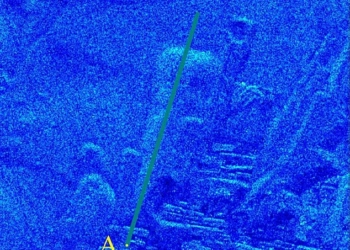
WHAT IS A JET STREAM?

Jet streams are fast-flowing, narrow currents of air that carry warm and cold air across the planet, much like the currents of a river.

They cover thousands of miles as they meander near the tropopause layer of our atmosphere.

They are found in the atmosphere’s upper levels and are narrow bands of wind that blow west to east.

The strongest jet streams are the polar jets, found 30,000 to 39,000ft (5.7 to 7.4 miles/ 9 to 12km) above sea level at the north and south pole.

In the case of the Arctic polar jet, this fast-moving band of air sits between the cold Arctic air to the north and the warm, tropical air to the south.

When uneven masses of hot and cold meet, the resulting pressure difference causes winds to form.

During winter, the jet stream tends to be at its strongest because of the marked temperature contrast between the warm and cold air.

The bigger the temperature difference between the Arctic and tropical air mass, the stronger the winds of the jet stream become.

Sometimes the flow changes direction and goes north and south.

Jet streams are strongest – in both the southern and northern hemispheres – during winters.

This is because boundaries between cold and hot air are the most pronounced during the winter, according to the National Weather Service (NWS).

The direction the air travels is linked to its momentum as it pushes away from the earth’s equator.

‘The reason has to do with momentum and how fast a location on or above the earth moves relative to earth’s axis,’ NWS explains.

The complex interactions of many factors, including low and high pressure systems, seasonal changes and cold and warm air – affect jet streams.

Source link

Related Posts

What happens if NASA’s moon mission goes wrong? The 5 worst-case scenarios for Artemis II, revealed – from a fireball on the launchpad to a medical crisis 250,000 miles away from Earth
Science

What happens if NASA’s moon mission goes wrong? The 5 worst-case scenarios for Artemis II, revealed – from a fireball on the launchpad to a medical crisis 250,000 miles away from Earth

February 15, 2026
The $80 billion mission to save the Doomsday Glacier: Scientists reveal wacky plan to build a 50-mile WALL around Thwaites to stop it collapsing and raising global sea levels by 2ft
Science

The $80 billion mission to save the Doomsday Glacier: Scientists reveal wacky plan to build a 50-mile WALL around Thwaites to stop it collapsing and raising global sea levels by 2ft

February 12, 2026
Would YOU try an offal Bolognese? Scientists are calling on Brits to eat ‘forgotten meats’ including tongue, heart, and kidneys to save the planet
Science

Would YOU try an offal Bolognese? Scientists are calling on Brits to eat ‘forgotten meats’ including tongue, heart, and kidneys to save the planet

February 9, 2026
Next Post
Lettuce will stay fresh for two weeks and not wilt if you add 1 kitchen item to fridge

Lettuce will stay fresh for two weeks and not wilt if you add 1 kitchen item to fridge

Company leaders needs to take safety as seriously as finance and growth

Company leaders needs to take safety as seriously as finance and growth

Trump ‘should be worried about Epstein’, lawmaker seethes as Andrew’s arrest sparks fresh fury

Trump 'should be worried about Epstein', lawmaker seethes as Andrew's arrest sparks fresh fury

Recommended

Iran-Israel drone attack LIVE: Israel strikes target in east Lebanon after it vowed to respond to the 300 drones and missiles sent by Iran in unprecedented attack

2 years ago
Apple’s $17bn smartwatch rescue mission: Tech giant races to avoid historic ban in the US that could last until 2028

Apple’s $17bn smartwatch rescue mission: Tech giant races to avoid historic ban in the US that could last until 2028

2 years ago
Homeowners warned as surge in fires linked to vapes may not be covered by insurers

Homeowners warned as surge in fires linked to vapes may not be covered by insurers

11 months ago
Prince William and Princess Charlotte, 10, are joined by Sir Keir Starmer and his wife at the Women’s Euro final – (but will the PM give us a day off if we win?)

Prince William and Princess Charlotte, 10, are joined by Sir Keir Starmer and his wife at the Women’s Euro final – (but will the PM give us a day off if we win?)

7 months ago

Categories

  • Business
  • Crypto
  • Entertainment
  • Food
  • Health
  • Home Improvment
  • Lifestyle
  • Motering/Cars
  • News
  • Opinion
  • Press Release
  • Real Estate
  • Science
  • Sports
  • Tech
  • Travel
  • World
No Result
View All Result

Highlights

Lettuce will stay fresh for two weeks and not wilt if you add 1 kitchen item to fridge

You think this is bad? Met Office warns Britain’s wet weather will continue until at least mid-MARCH

Ninja’s blendboss looks like the Stanley quencher of blenders – and it’s landed in the UK

Three tell-tale signs huge star is ‘confirmed’ as next James Bond | TV & Radio | Showbiz & TV

More than 1,200 people aged 85 and over died from ‘cold related illnesses’ last winter… just months after Labour banned winter fuel allowance

Europe’s best cities for guaranteed dry days revealed – as it’s rained every day of 2026 in the UK

London Mail

London Mail | Stay Informed, Stay Inspired ©2025, All rights Reserved

Navigate Site

  • Home
  • About
  • Advertise
  • Contact

Follow Us

No Result
View All Result
  • Home
  • Tech
  • News
  • Business
  • Science
  • Health
  • Sports
  • Lifestyle
  • Travel
  • Opinion

London Mail | Stay Informed, Stay Inspired ©2025, All rights Reserved